Fabric Consumption Calculator
Calculate your total fabric requirement based on per-piece consumption, order quantity and wastage.
Enter your order details to calculate.
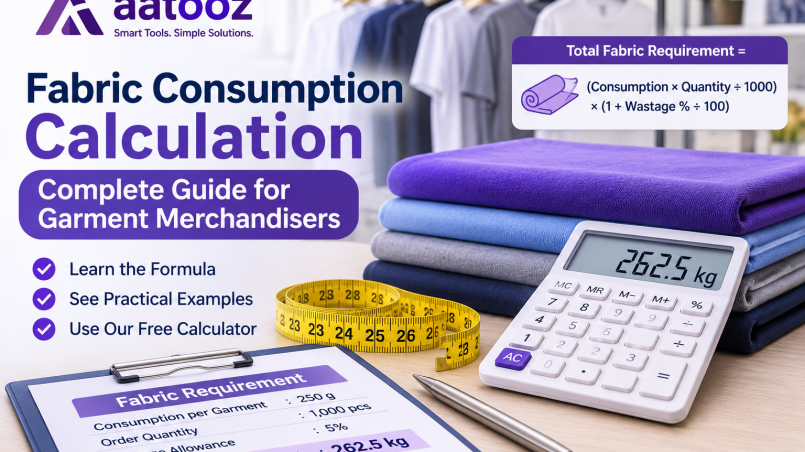
Formula: Total Fabric (kg) = (Consumption (g) × Quantity ÷ 1000) × (1 + Wastage % ÷ 100). This calculator assumes consumption is already established per garment.
Aatooz – Smart Tools. Simple Solutions.
Fabric Consumption Calculation: Complete Guide for Garment Merchandisers
Fabric consumption is one of the most important calculations in garment merchandising. It helps merchandisers estimate how much fabric is required to produce an order, prepare accurate costing, manage fabric booking, and reduce unnecessary wastage.
Whether you are handling T-shirts, hoodies, sweatshirts, trousers, or other garments, understanding fabric consumption is essential for smooth production planning.
In this guide, we will explain fabric consumption, the basic calculation formula, wastage allowance, and how to calculate the total fabric requirement for a garment order.
What Is Fabric Consumption?
Fabric consumption refers to the amount of fabric required to manufacture one garment or a specific quantity of garments.
It is generally measured in:
- Grams per piece (for many knitted garments)
- Yards per piece (commonly used for woven garments)
- Meters per piece
- Kilograms for bulk fabric requirements
For example, if one T-shirt requires 250 grams of fabric, its fabric consumption is 250 grams per piece.
Why Is Fabric Consumption Important?
Accurate fabric consumption helps garment merchandisers with:
- Costing: Calculate the fabric cost per garment.
- Fabric booking: Estimate the total fabric quantity needed for production.
- Order planning: Arrange fabric procurement according to order quantity.
- Inventory control: Avoid excess or insufficient fabric.
- Wastage management: Include a suitable allowance for cutting and production losses.
- Profitability: Maintain better control over garment manufacturing costs.
Basic Fabric Consumption Formula
For calculating total fabric requirements when per-piece consumption is already known:
Net Fabric Requirement (kg) = (Consumption per Piece in grams × Order Quantity) ÷ 1,000
To include wastage:
Total Fabric Requirement = Net Fabric Requirement × (1 + Wastage Percentage ÷ 100)
Example Calculation
Suppose you have the following order:
| Particulars | Quantity |
|---|---|
| Garment consumption | 250 grams |
| Order quantity | 1,000 pieces |
| Wastage allowance | 5% |
Step 1: Calculate net fabric requirement
(250 × 1,000) ÷ 1,000 = 250 kg
Step 2: Calculate wastage
250 × 5% = 12.5 kg
Step 3: Calculate total fabric requirement
250 + 12.5 = 262.5 kg
Therefore, the total fabric requirement is 262.5 kg.
How to Calculate Fabric Consumption Per Garment
Fabric consumption depends on several factors, including garment design, size, fabric width, GSM, pattern dimensions, marker efficiency, and fabric construction.
1. Knitted Garments
For knitted garments such as T-shirts, polo shirts, sweatshirts, and hoodies, consumption is often calculated in kilograms or grams per piece.
The garment's fabric requirement may be estimated using:
- Pattern or garment panel measurements
- Fabric GSM
- Marker efficiency
- Fabric width
- Size ratio
- Cutting and process allowances
A simplified area-based estimate is:
Fabric Weight (grams) = Fabric Area (square metres) × GSM
This gives the weight of a measured fabric area. For actual garment consumption, all required pattern pieces and applicable allowances must be considered.
2. Woven Garments
For woven garments such as shirts, trousers, jackets, and uniforms, consumption is often calculated in yards or meters per piece.
The calculation depends on:
- Fabric width
- Pattern layout
- Marker length
- Size ratio
- Garment construction
- Cutting wastage
Marker planning is particularly important because the same garment design can have different consumption depending on fabric width and marker efficiency.
What Is Fabric Wastage?
Fabric wastage is the additional fabric allowance included to cover losses during cutting and manufacturing.
Common reasons include:
- Cutting loss
- Fabric defects
- End-bit loss
- Shrinkage
- Spreading and handling loss
- Marker inefficiency
The wastage percentage should not be assumed to be the same for every order. It depends on fabric type, garment design, cutting method, factory efficiency, and buyer requirements.
For illustration, a 5% wastage allowance on 250 kg of net fabric requirement equals 12.5 kg.
Fabric Consumption vs. Fabric Requirement
These two terms are related but different.
| Term | Meaning |
|---|---|
| Fabric Consumption | Fabric needed per garment |
| Net Fabric Requirement | Consumption multiplied by order quantity |
| Wastage Allowance | Additional fabric for expected losses |
| Total Fabric Requirement | Net requirement plus wastage |
Understanding these differences helps avoid mistakes in fabric booking and order costing.
Calculate Your Fabric Requirement Online
You do not need to calculate everything manually.
Use the free Aatooz Fabric Consumption Calculator to estimate your total fabric requirement.
Enter:
- Consumption per garment in grams
- Total order quantity
- Wastage allowance percentage
The calculator will show:
- Net fabric requirement in kilograms
- Wastage quantity
- Total fabric requirement in kilograms
Try the free tool: Fabric Consumption Calculator
Frequently Asked Questions (FAQ)
1. What is the formula for fabric consumption?
For a known per-piece consumption in grams:
Fabric Requirement (kg) = (Consumption in grams × Order Quantity) ÷ 1,000.
2. How do I calculate fabric requirement for 500 T-shirts?
If each T-shirt consumes 200 grams:
(200 × 500) ÷ 1,000 = 100 kg.
If you add 5% wastage, the total requirement becomes 105 kg.
3. How do I calculate fabric wastage?
Wastage Quantity = Net Fabric Requirement × Wastage Percentage ÷ 100.
4. Is fabric consumption the same as GSM?
No. GSM means grams per square metre and indicates fabric weight per unit area. Fabric consumption refers to how much fabric is needed to make a garment.
5. Does fabric consumption depend on GSM?
Yes. For the same fabric area, a higher GSM generally means higher fabric weight. However, actual garment consumption also depends on pattern dimensions, garment design, fabric width, and marker efficiency.
Final Thoughts
Accurate fabric consumption calculation is essential for garment costing, fabric booking, and production planning. By understanding per-piece consumption, order quantity, and wastage allowance, merchandisers can estimate fabric requirements more effectively.
Use the Aatooz Fabric Consumption Calculator to make your calculations easier and faster.
Aatooz — Smart Tools. Simple Solutions.